
FRANCISSCHAEFFERSTUDIES VIDEOS

|

|

|

|

|

|

|

|
Saturday, November 12, 2011
ANNOUNCEMENT: THE SCHAEFFER LEGACY PROJECT - OUR FIRST INTERVIEW: DR. DAVID CALHOUN OF COVENANT THEOLOGICAL SEMINARY
At Francis Schaeffer Studies.org our desire is to share the works of Francis and Edith Schaeffer with the next generation as well as make their thought more accessible for general inquiry. Furthermore, we realize that the legacy of the Schaeffers goes on through people in the work of L'Abri and various other ministries throughout the world. Many of the people who knew the Schaeffers personally have significant memories to share and we would like to help preserve and share them in some small way, when we are privileged to do so. We are hoping this video will be the first of many more.
 In this video we invited Dr. David Calhoun, Professor of History Emeritus at Covenant Theological Seminary to speak with us and share about his experience with Dr. Schaeffer. Francis Schaeffer had a great impact on Dr. Calhoun's life in a very formative way and this interview gives us a glimpse into how people perceived Schaeffer in his early years and in the early life of L'Abri. Yet also tells us something of Schaeffer as a man and the ways in which he mentored so many. We hope that you will find this interview helpful in understanding why God used Dr. Schaeffer as an influential force in shaping so many lives.

Tuesday, November 1, 2011
BOOK ARTICLE: The Origins of Francis Schaeffer's "How Should We Then Live"
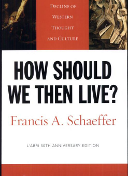
The initial film idea for How Should We Then Live video series that was released in 1976, is often said to have came from Francis Schaeffer's son Franky, who prodded his father to do a film. Very often, much is made of this by Franky, to suggest that he is the one who pushed his reluctant father into film. Yet recently, Rick Pearcy sent me a message that seems to indicate that Franky, although involved, was passing a suggestion along. "During a dinner with Franky, his wife, and another L'Abri student back in 1972-73, in the basement of Chalet les Melezes, I suggested to Franky that, given his dad's work in art, cultural analysis, and the history of ideas, FAS [Francis August Schaeffer] might put together a film series to answer Kenneth Clark's Civilisation. I saw it as a natural progression, a next step, in Schaeffer's work." says Pearcy. In an interview with Colin Duriez, Francis Schaeffer does indicate that Franky played a role in asking him, and he was definitely swayed by the opportunity to work on a project with his son. Yet he was not the sole influence. So although Schaeffer was at first reticent, there were additional factors that motivated Dr. Schaeffer's decision. The core early inspiration for a good portion of the historic content came much earlier from Schaeffer's tour of post-war Europe after WW II in 1947, where he was tasked with assessing the state of the children and churches for the Independent Board for Presbyterian Foreign Missions. Schaeffer had been chosen for this task due to the growing influence and impact of his and Edith's ministry Children For Christ. This tour would eventually result in the Schaeffer's being called to be missionaries to Europe to "Strengthen that which remains." He toured 31 cities (many more than once), in 13 countries in just 90 days and had seen first hand the destruction the humanist mindset could produce.
Yet further motivation resulted from the various documentaries that were being produced by historians that were giving revisionist, speculative analysis of western civilization. Schaeffer seems to have been already thinking along the same lines as Pearcy on the matter. In the aforementioned interview with Colin Duriez, Schaeffer recalls seeing Kenneth Clark's "Civilisation," released in 1969, on television and mentioning to Edith, "If I ever get a chance to hit that, I want to hit it," and so he did!
The first episode of Kenneth Clark’s Civilisation, called "The Skin of our Teeth," which tells you something of the nature of the historical commentary, opens with a shot of Michelangelo’s David, a shot similar to what we later see in How Should We Then Live. Herein, Clark says civilization got through the destruction of civilization the first time by the invading barbarians by the skin of it's teeth. He goes on to applaud man for being an “intelligent, creative and orderly, compassionate, animal.” One has to stop an laugh here, as I've personally never seen a raccoon out in the forest making art. Yet here, Clark wants to lessen man to a mere animal that somehow creates and is intelligent, orderly and compassionate. These of course are attributes of mankind created by God, with dignity and value more than a mere animal.
His next statement is, “What is civilization? I don’t know, but I think I can recognize it when I see it, and I’m looking at it right now.” Here the video pans to a view of the Notre Dame Cathedral behind him, which of course blatantly contradicts everything he just said. It's easy to see that he is making a romantic appeal to an example of civilization that he himself does not believe in. We can immediately see from the beginning of the documentary why Schaeffer became hungry to take on the task of rebuttal. Here is that first episode:
His next statement is, “What is civilization? I don’t know, but I think I can recognize it when I see it, and I’m looking at it right now.” Here the video pans to a view of the Notre Dame Cathedral behind him, which of course blatantly contradicts everything he just said. It's easy to see that he is making a romantic appeal to an example of civilization that he himself does not believe in. We can immediately see from the beginning of the documentary why Schaeffer became hungry to take on the task of rebuttal. Here is that first episode:
As Schaeffer points out, "...these ideas helped produce an even more far-reaching yet logical conclusion: the Nazi movement in Germany. Heinrich Himmler (1900-1945), leader of the Gestapo, stated that the law of nature must take its course in the survival of the fittest. The result was the gas chambers. Hitler stated numerous times that Christianity and its notion of charity should be “replaced by the ethic of strength over weakness.” Surely many factors were involved in the rise of National Socialism in Germany. For example, the Christian consensus had largely been lost by the undermining from a rationalistic philosophy and a romantic pantheism on the secular side, and a liberal theology (which was an adoption of rationalism in theological terminology) in the universities and many of the churches. Thus biblical Christianity was no longer giving the consensus for German society. After World War I came political and economic chaos and a flood of moral permissiveness in Germany. Thus, many factors created the situation. But in that setting the theory of the survival of the fittest sanctioned what occurred. "
It is our hope that by seeing the larger picture of the reasons behind How Should We Then Live our eyes will be opened to what Schaeffer was really speaking to. In many ways these accusations are perhaps far more sinister that what we might have realized.
For a wonderful explanation on How Should We Then Live, see Ronald Macaulay's video from the 2008 Francis Schaeffer Conference in 2008, sponsored by the L. Rush Bush Center for Faith and Culture.
Ranald Macaulay - Schaeffer in the 21st Century from Southeastern Seminary on Vimeo.
Monday, October 31, 2011
NEW VIDEO: Francis Schaeffer at International Congress of World Evangelism, Lausanne, Switzerland, July 1974
During our research on Life & Works of Francis Schaeffer, we discovered this video segment of Francis Schaeffer at first International Congress of World Evangelism at Lausanne, Switzerland, July 1974. Where Schaeffer spoke with other great evangelical leaders of the time such as Billy Graham, John Stott, & Malcolm Rutledge. We edited out this segment and from the post-conference file produced by the Billy Graham Evangelistic Association called Let the Earth Hear His Voice (entire video here). Watch the Schaeffer segment below!
This short segment includes several wonderful quotes, one of which is as follows:
"There is no use of Evangelicalism seeming to get larger and larger, if at the same time appreciable parts of Evangelicalism are getting soft at that which is the central core, namely the Scriptures." ~ Francis Schaeffer
This short segment includes several wonderful quotes, one of which is as follows:
"There is no use of Evangelicalism seeming to get larger and larger, if at the same time appreciable parts of Evangelicalism are getting soft at that which is the central core, namely the Scriptures." ~ Francis Schaeffer
Saturday, September 17, 2011
NEWS: THE LIFE & WORKS OF FRANCIS SCHAEFFER CLASS RESOURCES
There are multiple new resources available for the study of the Life & Works of Francis and Edith Schaeffer. Take note of these two previous post, and also the latest information that follows.
ABOUT THE CLASS
FOLLOWING THE CLASS ON FACEBOOK
Important Class Materials:
Life & Works Timeline Spreadsheet
Works Overview & History Spreadsheet
New resources for the Study of Francis Schaeffer
Facebook Works of Francis Schaeffer Cover Photo Album
New resources for the Study of Edith Schaeffer
New Facebook Fan Page
Facebook Works of Edith Schaeffer Cover Photo Album
Reference Edith's Works on FrancisSchaefferStudies.org
We hope these resources will aid you in your reading of the works of Francis & Edith Schaeffer!
ABOUT THE CLASS
FOLLOWING THE CLASS ON FACEBOOK
Important Class Materials:
Life & Works Timeline Spreadsheet
Works Overview & History Spreadsheet
New resources for the Study of Francis Schaeffer
Facebook Works of Francis Schaeffer Cover Photo Album
New resources for the Study of Edith Schaeffer
New Facebook Fan Page
Facebook Works of Edith Schaeffer Cover Photo Album
Reference Edith's Works on FrancisSchaefferStudies.org
We hope these resources will aid you in your reading of the works of Francis & Edith Schaeffer!
Wednesday, September 14, 2011
Tuesday, September 6, 2011
NEWS: FOLLOW THE LIFE & WORKS OF FRANCIS SCHAEFFER CLASS ON FACEBOOK
 |
- Access to Related Articles
- Detailed Class Notes
- Class Resources
- Downloadable Audio (when available)
- Video (when available)
- The latest news and information
If you are not already a friend with us on Facebook, you can friend us here. We'd love to get to know you and hear your thoughts on Schaeffer.
Or if you just want to check out the page first, select the link below to see the new tab!
The Life & Works Of Francis Schaeffer
Saturday, September 3, 2011
NEWS: THE LIFE & WORKS OF FRANCIS SCHAEFFER CLASS FILMING BEGINS
"Brothers, join in imitating me, and keep your eyes on those who walk according to the example you have in us." Phil. 3:17
We are very excited about the Life and Works of Francis Schaeffer class, which will start filming this Sunday! We will be covering the life and works of Francis and Edith Schaeffer. We are including Edith's works to be true to how Schaeffer saw his works himself. He saw his works and Edith’s works as part of a greater whole. As Schaeffer says in the preface to his complete works, “All of the books are to be read and understood together (along with my wife Edith’s books). They together are a unit.” (Note: Due to time, we will only be giving brief overviews of Edith's works to give context as they relate an enhance to Dr. Schaeffer's works.)
CLASS LOCATION
The class will be at Redeemer Presbyterian Church in Overland Park, KS on Sunday Morning (Adult Sunday School Hour). See http://redeemer-pca.org/ if you would like to attend.
CLASS INTENT
The class is intended to not only give an overview of their life and history, but to give background information on each of their books and specifically in the case of Francis Schaeffer, the context into which they were written.
RESEARCH BEHIND THE CLASS
The class was formulated by taking the time line provided by Lane T. Denis in the Letters of Francis Schaeffer and then enhancing and overlaying it with the dates of the works of Francis and Edith. Then we further augmented the time line with details from Jeram Barr's very wonderful and granular lectures on the life of Schaeffer (Francis A. Schaeffer: The Early Years & The Later Years) and specifics from Colin Duriez's book, Francis Schaeffer an Authentic Life, which is an honest an excellent, treatment.
In addition to this, we created a "works overview" time line, where we further researched Schaeffer's comments on each book, when available, as well as the historical background behind them to gain an understanding of the context of which they were written. Other sources included Edith's four historical books: L'Abri, The Tapestry, and her two volumes of the L'Abri letters (With Love, Edith 1948-1960 , Dear Family 1961-1968 ) .
We feel the value of this project is that people will be able to quickly, at-a-glance, get a "big picture" understanding of what Schaeffer was all about. Our goal in all of our work here at Francis Schaeffer Studies is about providing a service in furthering the Schaeffer legacy. We each here at Francis Schaeffer Studies are but the "man on the street" trying to introduce ideas "into the public square." We believe this is what Schaeffer intended to be done with his works.
USAGE OF VIDEOS
Our plan is to use the videos to both enhance francisschaefferstudies.org as well as provide a concise series of videos that give people and introduction and context to Dr. Schaeffer's works. All of these videos and class materials will be made freely available via the web. Watch for information, notes, discussion, audio downloads, and video as they become available! We will do the best we can to pull things together quickly. Obviously video editing takes some time. Follow this blog and our Facebook page for the latest news.
Pray for us as we start the filming on this very important work!
Dan Guinn
Founder of FSS.
We are very excited about the Life and Works of Francis Schaeffer class, which will start filming this Sunday! We will be covering the life and works of Francis and Edith Schaeffer. We are including Edith's works to be true to how Schaeffer saw his works himself. He saw his works and Edith’s works as part of a greater whole. As Schaeffer says in the preface to his complete works, “All of the books are to be read and understood together (along with my wife Edith’s books). They together are a unit.” (Note: Due to time, we will only be giving brief overviews of Edith's works to give context as they relate an enhance to Dr. Schaeffer's works.)
CLASS LOCATION
The class will be at Redeemer Presbyterian Church in Overland Park, KS on Sunday Morning (Adult Sunday School Hour). See http://redeemer-pca.org/ if you would like to attend.
CLASS INTENT
The class is intended to not only give an overview of their life and history, but to give background information on each of their books and specifically in the case of Francis Schaeffer, the context into which they were written.
RESEARCH BEHIND THE CLASS
The class was formulated by taking the time line provided by Lane T. Denis in the Letters of Francis Schaeffer and then enhancing and overlaying it with the dates of the works of Francis and Edith. Then we further augmented the time line with details from Jeram Barr's very wonderful and granular lectures on the life of Schaeffer (Francis A. Schaeffer: The Early Years & The Later Years) and specifics from Colin Duriez's book, Francis Schaeffer an Authentic Life, which is an honest an excellent, treatment.
In addition to this, we created a "works overview" time line, where we further researched Schaeffer's comments on each book, when available, as well as the historical background behind them to gain an understanding of the context of which they were written. Other sources included Edith's four historical books: L'Abri, The Tapestry, and her two volumes of the L'Abri letters (With Love, Edith 1948-1960 , Dear Family 1961-1968 ) .
DISCLAIMER
We realize that this class will not be exhaustive, yet we hope that it will be helpful to the Francis Schaeffer and L'Abri community as well as to those who are seeking an introduction and understanding of Schaeffer. We also will do our best to make ongoing corrections to any historical errors or misrepresentations that might happen.We feel the value of this project is that people will be able to quickly, at-a-glance, get a "big picture" understanding of what Schaeffer was all about. Our goal in all of our work here at Francis Schaeffer Studies is about providing a service in furthering the Schaeffer legacy. We each here at Francis Schaeffer Studies are but the "man on the street" trying to introduce ideas "into the public square." We believe this is what Schaeffer intended to be done with his works.
USAGE OF VIDEOS
Our plan is to use the videos to both enhance francisschaefferstudies.org as well as provide a concise series of videos that give people and introduction and context to Dr. Schaeffer's works. All of these videos and class materials will be made freely available via the web. Watch for information, notes, discussion, audio downloads, and video as they become available! We will do the best we can to pull things together quickly. Obviously video editing takes some time. Follow this blog and our Facebook page for the latest news.
Pray for us as we start the filming on this very important work!
Dan Guinn
Founder of FSS.
Friday, August 19, 2011
ARTICLE: ERRONEOUS CHARGES OF DOMINIONISM & THEOCRACY
Of late there have been charges floating around about Michele Bachmann, Nancy Pearcy, and Francis Schaeffer charging the lot with Dominionism. The term as I understand it, advocates the principle of a theocratic state, whereby the government would be explicitly ruled by God, via Biblical Law in a modern context [Note here that the accusation is actually using the wrong terminology, as the school of thought is generally known as Recondstructionism or Theonomy]. The purpose of this brief article is not to debate over the validity of that subject, but to speak to Schaeffer's views. As you know, our study here is not focused on Michelle Bachman or Nancy Pearcy, but on Francis Schaeffer and his works. So to quickly clarify, was Francis Schaeffer a theonomist or not?
It is quite clear that Schaeffer believed in the rule of law, under God, as all of our founding fathers did. He further believed in a concept of a "Christian consensus." He did not believe that the Christian consensus, was a group of true believers, but it was a prevailing Christian worldview that was present as a product of the Protestant Reformation in America at the time of the founding of the United States. Yet Schaeffer clearly stopped short of holding the view of a theocracy for several important reasons.
Firstly, Schaeffer believed that the founding fathers of the United States never envisioned a theocratic state.
Secondy, Schaeffer saw that because of the depravity of sinful man (mankind), that mankind would not continue to govern rightly or perfectly and would eventually abuse authority, even under a theocratic state (although he did not believe we should simply ignore politics either). He believed that the natural end of a theocracy would be just a different type of authoritarianism.
Thirdly, Schaeffer felt that Christianity was only capable of a substantial healing in the area of government, as true government could only be obtained in the return of Christ. Contrary to popular belief, he did not advocate the uniting of church and state (and neither do most Reconstructionist for that matter).
So what did Francis Schaeffer think the role of the Christian in government should be?
All of these quotes clearly show what Schaeffer's view was on the subject and it is disheartening to hear that he is now being mislabeled in the current political climate. He no doubt would view these debates as quite ugly in my opinion.
Ultimately, Schaeffer's real view on government would first include organically influenced government, as it seems apparent that Schaeffer's belief was that the role of Christianity in politics is to naturally influence government by being transforming first in the person, then in one's relationships, then in the church, then in the total culture, including government and the whole of life. This is outlined in his book True Spirituality, interestingly enough. Since mankind was created in the image of God and this is where mankind obtains dignity, the natural influence of this dignity was brought about by respect and care for others and holding fast to the truth. In this light, the only way naturally to bring about lasting change in government is by changing the human heart. That change alters our worldview and also how that we vote and the influence we have on government. So there is to be action on our part in government, but it is never the final solution to man's problems, as ultimate transformation in government will come upon Christ's return.
Simply put, Schaeffer's organic approach is just simply Christianity doing what it does when it is practiced at it's best, being humanitarian and transforming the world with truth from the inside out. Schaeffer believed that real transformation could only be accomplished by showing the true love of Christ, and standing on His transformational Truth.
Articles of interest:
Dangerous Influences: The New Yorker, Michele Bachmann, and Me (Nancy Pearcy)
Francis Schaeffer, Dominionism, and Christians in the Public Square (Jerram Barrs)
Michele Bachmann and Dominionism Paranoia (Douglas Groothuis)
The Rutherford Institute: Setting the Record Straight: Michele Bachmann, Francis Schaeffer (John W. Whitehead)
Additional Articles:
Schaeffer, Pearcey, The New Yorker, and American Grace (and other good books on faith and the public
WORLDmag.com | Secular leaps of faith
Bachmann and dominionism - sacbee.com
It is quite clear that Schaeffer believed in the rule of law, under God, as all of our founding fathers did. He further believed in a concept of a "Christian consensus." He did not believe that the Christian consensus, was a group of true believers, but it was a prevailing Christian worldview that was present as a product of the Protestant Reformation in America at the time of the founding of the United States. Yet Schaeffer clearly stopped short of holding the view of a theocracy for several important reasons.
Firstly, Schaeffer believed that the founding fathers of the United States never envisioned a theocratic state.
- "We must make definite that we are in no way talking about any kind of theocracy. Let me say that with great emphasis. Witherspoon, Jefferson, the American Founders had no idea of a theocracy. That is plain by the First Amendment, and we must continually emphasize the fact that we are not talking about some kind, or any kind of theocracy." ~ Francis Schaeffer, A Christian Manifesto
Secondy, Schaeffer saw that because of the depravity of sinful man (mankind), that mankind would not continue to govern rightly or perfectly and would eventually abuse authority, even under a theocratic state (although he did not believe we should simply ignore politics either). He believed that the natural end of a theocracy would be just a different type of authoritarianism.
- "The non-Christian, in the twentieth century especially, has no legal and moral base. Everything floats in space: a 51 percent vote of some type of right-wing or left-wing authoritarianism must decide what is acceptable, or some form of hedonism must be adopted, because as Plato understood so well, an absolute is necessary for real morality. Plato never found such and absolute, but he understood the problem and so did the Neoplatonimen of the Renaissance." ~ Francis Schaeffer, Death In The City
Thirdly, Schaeffer felt that Christianity was only capable of a substantial healing in the area of government, as true government could only be obtained in the return of Christ. Contrary to popular belief, he did not advocate the uniting of church and state (and neither do most Reconstructionist for that matter).
- "There is no New Testament basis for a linking of church and state until Christ, the King returns. The whole 'Constantine mentality' from the fourth century up to our day was a mistake. Constantine, as the Roman Emperor, in 313 ended the persecution of Christians. Unfortunately, the support he gave to the church led by 381 to the enforcing of Christianity, by Theodosius I, as the official state religion. Making Christianity the official state religion opened the way for confusion up until our own day. There have been times of very good government when this interrelationship between of church and state has been present. But through the centuries it has caused great confusion between loyalty to the state and loyalty to Christ, between patriotism and being a Christian. We must not confuse the Kingdom of God with our country. To say it another way: 'We should not wrap Christianity in our national flag.'" ~ Francis Schaeffer, A Christian Manifesto.
So what did Francis Schaeffer think the role of the Christian in government should be?
- "None of this, however, changes the fact that the United States was founded upon a Christian consensus, nor that we today should bring Judeo-Christian principles into play in regard to government. But that is very different from a theocracy in name or in fact." ~ Francis Schaeffer, A Christian Manifesto.
All of these quotes clearly show what Schaeffer's view was on the subject and it is disheartening to hear that he is now being mislabeled in the current political climate. He no doubt would view these debates as quite ugly in my opinion.
Ultimately, Schaeffer's real view on government would first include organically influenced government, as it seems apparent that Schaeffer's belief was that the role of Christianity in politics is to naturally influence government by being transforming first in the person, then in one's relationships, then in the church, then in the total culture, including government and the whole of life. This is outlined in his book True Spirituality, interestingly enough. Since mankind was created in the image of God and this is where mankind obtains dignity, the natural influence of this dignity was brought about by respect and care for others and holding fast to the truth. In this light, the only way naturally to bring about lasting change in government is by changing the human heart. That change alters our worldview and also how that we vote and the influence we have on government. So there is to be action on our part in government, but it is never the final solution to man's problems, as ultimate transformation in government will come upon Christ's return.
Simply put, Schaeffer's organic approach is just simply Christianity doing what it does when it is practiced at it's best, being humanitarian and transforming the world with truth from the inside out. Schaeffer believed that real transformation could only be accomplished by showing the true love of Christ, and standing on His transformational Truth.
Articles of interest:
Dangerous Influences: The New Yorker, Michele Bachmann, and Me (Nancy Pearcy)
Francis Schaeffer, Dominionism, and Christians in the Public Square (Jerram Barrs)
Michele Bachmann and Dominionism Paranoia (Douglas Groothuis)
The Rutherford Institute: Setting the Record Straight: Michele Bachmann, Francis Schaeffer (John W. Whitehead)
Additional Articles:
Schaeffer, Pearcey, The New Yorker, and American Grace (and other good books on faith and the public
WORLDmag.com | Secular leaps of faith
Bachmann and dominionism - sacbee.com
Thursday, August 18, 2011
ARTICLE: CONSIDERING MEDITATION
What is meditation? Does it have a place in the practice of True Spirituality? Dan explores this topic in depth, examining the abuses and scriptures perspective. Visit the Asecular Truth Blog and read his article entitled, "Meditation on Truth."
~ http://aseculartruth.blogspot.com/2011/08/meditation-on-truth.html
~ http://aseculartruth.blogspot.com/2011/08/meditation-on-truth.html
Sunday, August 7, 2011
NEWS: MORE FRANCIS SCHAEFFER VIDEO CHANNELS!
Francis Schaeffer Studies now is on multiple video platforms!
You can now find us on Youtube, Godtube, and Vimeo. Choose your favorite channel and tune in! Watch for new videos here at they become available.
schaefferstudies on Godtube
schaefferstudies on Vimeo
schaefferstudies on Youtube

You can now find us on Youtube, Godtube, and Vimeo. Choose your favorite channel and tune in! Watch for new videos here at they become available.
schaefferstudies on Godtube
schaefferstudies on Vimeo
schaefferstudies on Youtube
Subscribe to:
Posts (Atom)